
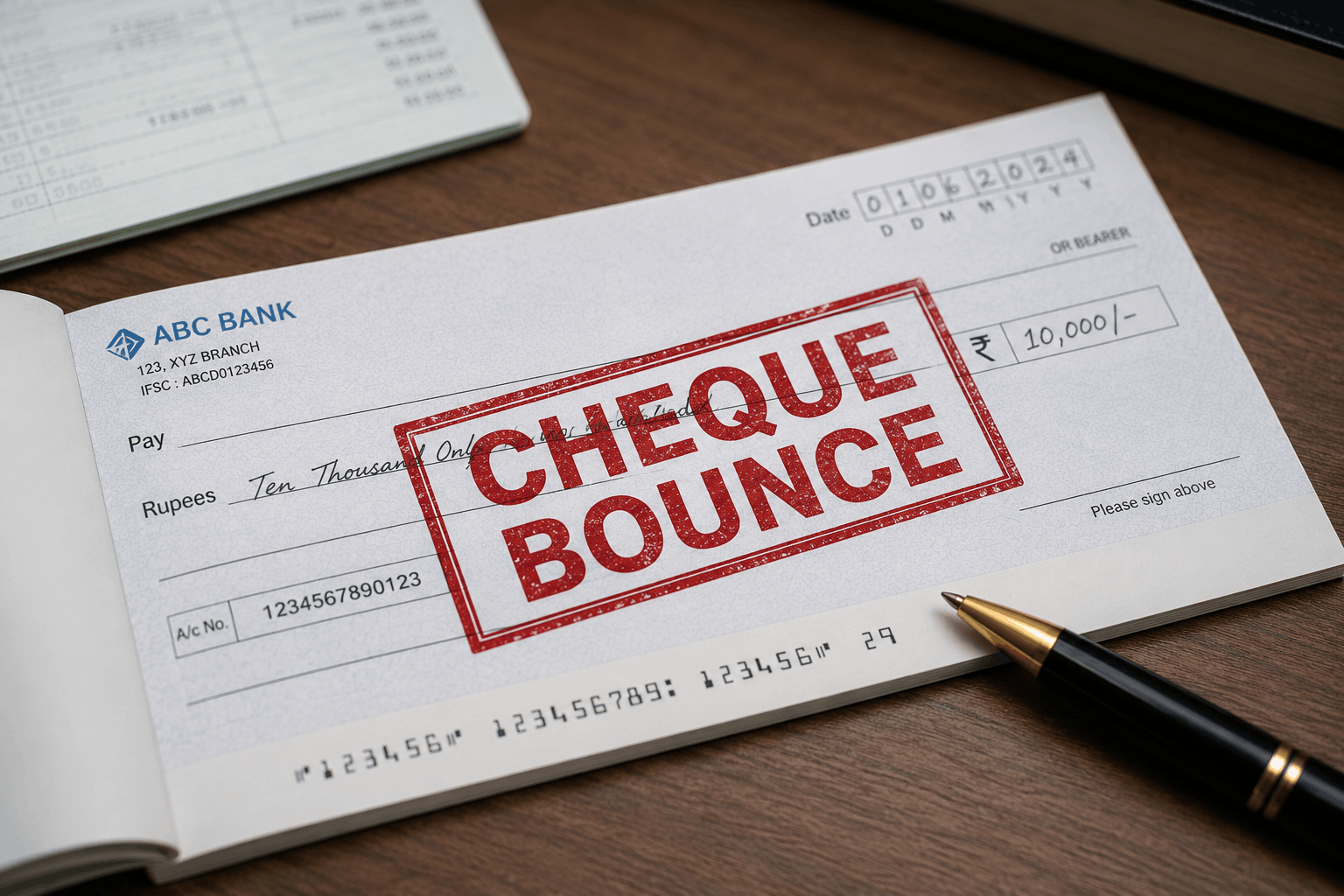
One of the most frequently used financial instruments in business transactions, loan payments, rent payments and personal transactions is a cheque. But a bounced cheque may lead to financial difficulties and legal problems for the issuer and the recipient. On the other hand, the cheque bounce cases in India are governed by primarily by Section 138 of the Negotiable Instruments Act, 1881 which gives legal remedies to the aggrieved party.
It’s important to know your legal rights and what you need to do if a cheque has been returned unpaid so you can recover your money and protect your interests.
What does COPYING TO THE CASHIER – COPY RETURNED UNPAID mean?
The bank will consider a cheque to be returned unpaid or dishonoured if it will not accept the payment specified on the cheque. A cheque return memo is issued by the bank explaining the reasons for the bank’s dishonour of the cheque.
Common reasons include:
This is to alert you that there is not enough money in your account.
* Account closed
* Signature mismatch
The drawer has stopped payment on the check.The drawer has made a stop payment on a check.
Fails to comply with arrangement with bank
The cheque must be altered in the manner described below:
The legal framework for cheque bounce cases.
The Negotiable Instruments Act, 1881, governs the cheque bounce issues. Section 138 punishes the cheque dishonour for a cheque issued for an enforceable debt or liability which is returned dishonoured.
The law aims to maintain trust and credibility in commercial transactions and prevent misuse of cheque-based payments.
To pursue a cheque bounce case, certain conditions need to be fulfilled:
The following conditions must be met to file a lawsuit under Section 138:
A debt or liability that is legally binding.A debt or liability that is enforceable by law.
The cheque had to have been issued to repay a legally binding debt, loan, business transaction or financial obligation.
The presentation is within the validity period.
The cheque has to be submitted to the bank, and it is valid till the date mentioned on it.
3. Dishonour by the Bank
The bank should send the cheque back and provide a return memo with the reason for such a return.
4. Legal Demand Notice
Payee is required to issue a legal demand notice to drawer within the time period after receiving information relating to dishonour.
5. Failure to Make Payment
Should the drawer not pay within the time specified in the law after receiving the notice, a criminal complaint can be filed.
What to do if a cheque is returned unpaid.
When you receive a bounced cheque, you have the following rights:
Right to Receive Payment
A right to recover the amount as mentioned in the cheque.
Right to Send a Legal Notice
A formal legal notice can be sent to the drawer for the money to be paid.
Anyone can file a criminal complaint.A criminal complaint may be filed by anyone.
You can start a criminal action if payment is not received after the notice period.
Right to Seek Compensation
The courts can compensate a person for financial losses, costs of litigation, and for loss of the cheque itself.
The right to be compensated for civil remedies.
In addition to criminal actions, a civil recovery action may be filed to recover money, with the exception of criminal proceedings.
When a cheque is bounced, the whole process is a step-by-step one.
Step 1: Get the Cheque Return Memo.
If the cheque is returned by the bank, it sends a return memo stating the grounds for return.
Step 2: Check with a Legal Professional
A seasoned attorney has the ability to review the facts and advise you on your legal options.
The third step is to send a Legal Demand Notice.
Enclose a legal notice asking for the cheque to be paid.
The notice shall include at a minimum:
* Details of the cheque
* Amount involved
* Date of dishonour
* Reason for dishonour
* Demand for payment
Step 4: Wait and Compliance
After receipt of notice, the drawer will be afforded a chance to pay the outstanding amount.
Step 5: Present a Complaint to the Competent Court
A complaint can be made in front of the competent court within the time limit.
Required documents for a Cheque Bounce case.Cheque Bounce Case Document Requirements.
In order to bolster your argument, have the following documents readily available:
* Original cheque
* Bank return memo
* Copy of legal notice
* Confirmation of payment and receipt of letters.* Proof of payment and receipt for mail.
* Bank account statements
Loan agreement or transaction records
Documentation will go far to help ensure successful recovery.
Rewards for the Drawer
Cheque dishonour can have serious legal consequences.
Criminal Liability
The drawer could be convicted of committing an offence under Section 138, Negotiable Instruments Act on this basis.
Financial Penalties
Monetary fines and damages may be awarded.
Damage to Reputation
Cheque bounce cases can have a negative impact on business reputation and individual reputation.
The effect on future transactions.
Banks, lenders and business partners might be wary about their involvement in multiple cheque dishonour issues.
This is a common defence that may be raised in the case of cheque bounce.
The drawer might raise some legal defences, like:
No debt was due and owing legally
The security (Cheque) was issued only as a cheque.
* Signature was forged
The editing of material in a cheque.The modification of the material used in a cheque.
* Payment already made
The validity of these defences depends on facts and supporting evidence.
The following are some tips to avoid cheque bounce problems.
When you’re sending or getting cheques, take the following precautions:
Having enough money in the account
Be sure to check the cheque before giving it out
– Do not overwrite and changes to files
Carefully use of post-dated cheques.
* Preserve transaction records
The need for professional legal help is of great consequence.The role of legal professionals is extremely significant.
There is a strict procedure and time limit for cheque bounce cases. Failure to meet deadlines or provide the proper documentation can impact legal rights. Professional legal support ensures adherence with statutory obligations, accurate preparation of notices, representation in court and utilization of strategic methods for recovering dues.
If a cheque is returned unpaid, it can cause a serious hindrance to personal and commercial life but there are adequate remedies under Indian law to safeguard the cause of the aggrieved party. It’s important to know your rights, keep relevant documents, serve a proper legal notice and then take the necessary legal action in order to get the money back. As a person, business owner, lender or creditor, swift legal action can make a difference in terms of a successful resolution.